
 Amos Oge Kalu
By Sa’adiyyah Adebisi Hassan
Nigeria’s tragedy is not a lack of leaders but a culture of dishonesty especially when judging power. We romanticize failure, weaponize nostalgia, and punish reform. This is a blunt assessment of Nigeria’s recent presidents across core governance pillars.
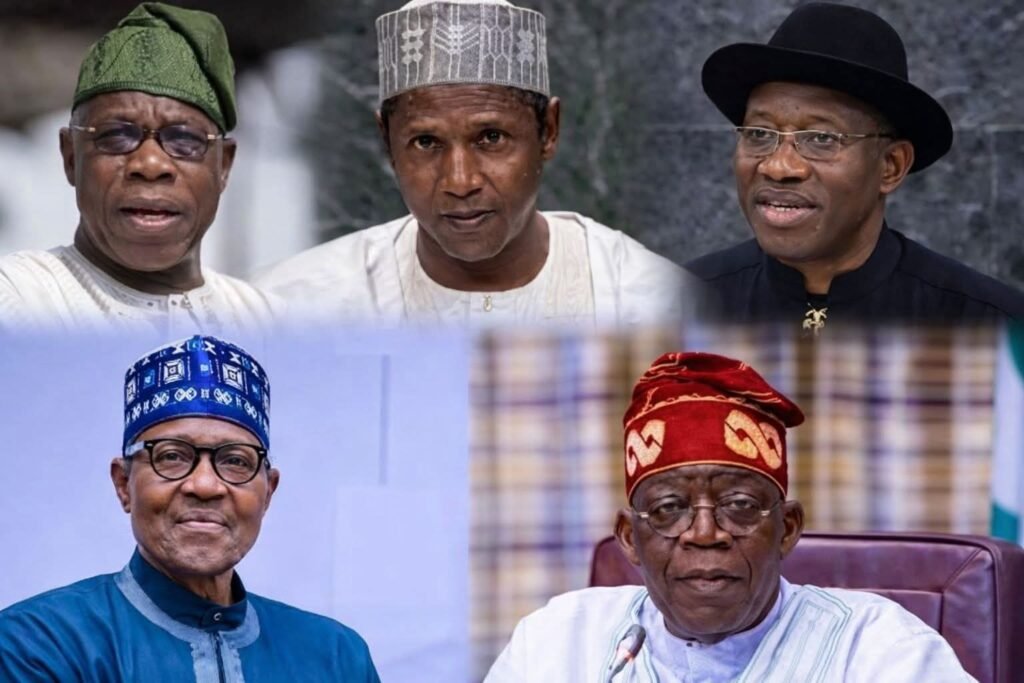
Olusegun Obasanjo (1999–2007): Economic Repair, Democratic Abuse
Obasanjo deserves credit for stabilizing Nigeria’s economy after decades of military misrule and restoring Nigeria’s international standing. Debt relief and diplomatic reintegration were real achievements.
However, politically, he governed like a civilian dictator. Institutions existed, but power overrode them. The third-term agenda alone disqualifies him from any democratic sainthood. Anti-corruption was selective. The rule of law was conditional. Electoral reform was cosmetic.
Verdict: Economic gains achieved at the expense of democratic norms.
Umaru Musa Yar’Adua (2007–2010): Integrity Interrupted
Yar’Adua remains Nigeria’s most principled modern president. He acknowledged the flaws in his election, strengthened judicial independence, respected court rulings, and pursued genuine electoral reform.
Corruption was restrained not by noise but by institutional discipline. His weakness was foreign policy – Nigeria became inward-looking and less assertive globally.
His death, not incompetence, ended a rare experiment in ethical governance.
Verdict: The right direction, tragically unfinished.
Goodluck Jonathan (2010–2015): Democratic Space Without Control
Jonathan expanded civil liberties, improved elections, respected the judiciary, and maintained diplomatic relevance. Economically, Nigeria experienced growth.
But corruption flourished – not because Jonathan promoted it, but because he failed to confront it decisively. Political drift, security breakdowns, and administrative weakness defined his later years.
Good intentions are not governance.
Verdict: Liberal governance undermined by permissiveness.
Muhammadu Buhari (2015–2023): Discipline Without Delivery
Buhari promised integrity and delivered economic decline. Inflation, unemployment, and poverty worsened. His anti-corruption war was loud but selective, often targeting opponents while shielding allies.
Court orders were ignored. Institutions weakened. Yet, credit where due: electoral reforms, especially technological improvements, advanced under his tenure – even if his politics contradicted them.
Verdict: Moral branding without economic or institutional competence.
Asiwaju Bola Ahmed Tinubu (2023– ): The Strategist Gambling with Fire
Tinubu is a political tactician, not a moralist. He understands power, negotiation, and statecraft. His economic reforms – fuel subsidy removal and FX unification – are bold and necessary.
Contrary to lazy narratives, Tinubu’s era is not corrupt. It is tight, controlled, and aggressively reformist.
Fuel subsidy removal and FX unification shut down some of Nigeria’s largest corruption pipelines. That is not theory – it is arithmetic. Billions once stolen quietly are no longer leaking through policy loopholes.
This is why the noise is loud.
Corruption thrives in opacity, Tinubu is forcing transparency that hurts entrenched interests. The discomfort Nigerians feel is not corruption – it is adjustment.
Where Tinubu struggles is perception management and institutional communication. The rule of law still needs strengthening, and electoral reform requires deeper commitment. Foreign policy lacks coherence and strategic messaging.
But on corruption? There is no room to steal comfortably anymore.
Verdict: Painful reforms, corruption chokehold, governance still evolving.
The Uncomfortable Truth Nigerians Must Swallow
Nigeria has never lacked intelligent leaders.
It has lacked ethical courage, institutional respect, and long-term discipline.
We don’t need saints.
We need leaders who fear institutions more than power.
Until Nigerians stop lying to themselves about their leaders, Nigeria will keep recycling failure – under different faces.
This assessment is based on observable policies, institutional behavior, and outcomes – not sentiment, party loyalty, or tribal attachment.
Nigeria’s history deserves honest debate, not emotional revisionism.
I stand to be corrected.
Copyright Warning!
Disclaimer
Just to let you know, comments expressed here do not reflect the opinions of OHAFIATV News or any employee thereof. Also, every opinion expressed in any article is strictly that of the author(s), except where otherwise stated.

ATTENTION: Stay informed and ahead of the curve! Follow OHAFIATV on WhatsApp for updates! CLICK HERE!
Have any thoughts?
Share your reaction or leave a quick response — we’d love to hear what you think!
-
 0
0
-
 0
0
-
 0
0
-
 0
0
-
 0
0
-
 0
0