
 Amos Oge Kalu
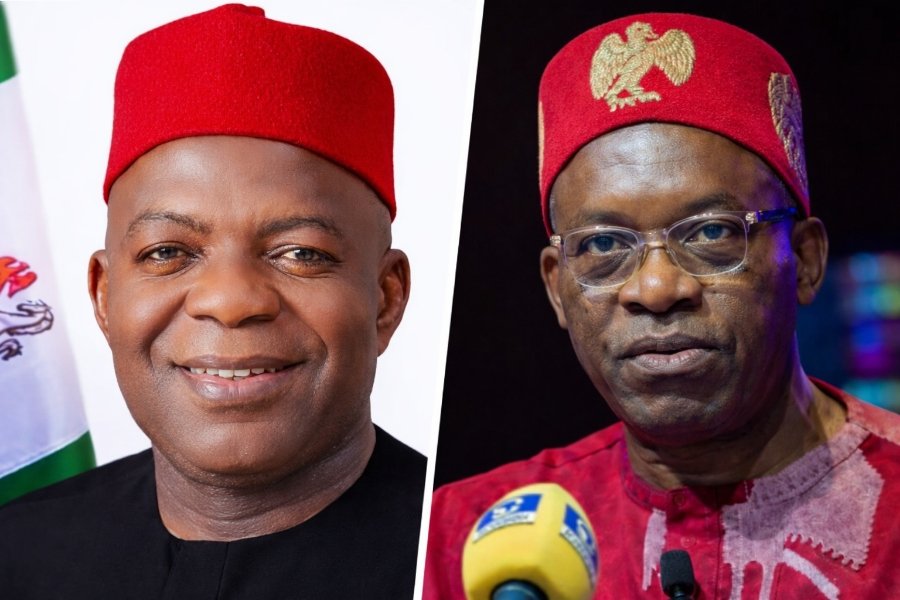
Governor Alex Chioma Otti of Abia State and Governor Charles Chukwuma Soludo of Anambra State both emerged from distinguished careers in the banking sector, where strategic thinking, fiscal discipline, and institutional reform are central to success. Their transitions into public office generated widespread expectations that such technocratic expertise would translate into efficient governance, infrastructure renewal, and improved economic management at the state level.
Few years into their administrations, however, differences in approach, execution, and outcomes have become increasingly discernible. A comparative assessment of two major commercial hubs—Ariaria International Market in Aba and Onitsha Main Market in Onitsha—provides a practical lens through which these differences can be evaluated.
Market Infrastructure and Government Response
Onitsha Main Market remains Africa’s largest market by volume of trade and a critical pillar of commerce in the South-East. Its traders drive regional supply chains, sustain thousands of jobs, and contribute significantly to Anambra State’s internally generated revenue. Despite this economic weight, the market continues to face longstanding infrastructural challenges, including deteriorated road networks, limited modern facilities, and exposure to repeated disruptions arising from security and sit-at-home directives. These closures, irrespective of their underlying causes, have had measurable economic consequences, weakening commercial confidence and disrupting continuity in one of the region’s most important trading centres.
By contrast, Ariaria International Market in Aba reflects a more interventionist and reform-driven trajectory. Although redevelopment is ongoing, a completed phase comprising roughly 5,000 lock-up shops is already operational, with additional phases progressing. The redevelopment effort demonstrates visible planning, improved spatial organisation, and upgraded facilities designed to enhance trader efficiency and safety. Importantly, development has been executed in phases that allow commercial activity to continue rather than be paralysed.
This contrast highlights not a difference in trader capacity—both markets are sustained by highly industrious business communities—but a difference in the scale, consistency, and prioritisation of government intervention.

Administrative Execution and Broader Governance Indicators
Beyond market infrastructure, Governor Alex Otti’s administration has distinguished itself through a broader pattern of administrative reforms and governance outcomes. His government has prioritised fiscal transparency, public sector restructuring, and infrastructure rehabilitation across key sectors. Within a relatively short period, Abia State has recorded visible improvements in road construction and rehabilitation, urban renewal projects, health facility upgrades, and civil service wage regularity—areas long considered weak points in the state’s governance history.
In addition, Otti’s approach has emphasised contract rationalisation, cost control, and the redirection of public funds toward measurable outcomes rather than recurrent leakages. This has helped restore a level of public confidence in state institutions and reposition Abia as a state undergoing systematic recovery rather than episodic intervention.
While Governor Soludo’s administration in Anambra has articulated ambitious policy frameworks, particularly around economic transformation and urban planning, the translation of these frameworks into consistently visible, trader-facing outcomes—especially in flagship commercial assets like Onitsha Main Market—has been slower and less pronounced by comparison.
Governance Philosophy and Economic Priorities
The divergence between Ariaria and Onitsha markets reflects a deeper difference in governance philosophy. Governor Otti’s administration appears to place strong emphasis on practical execution, phased development, and immediate impact on productive sectors. The focus is less on grand theorisation and more on restoring functionality to institutions and infrastructure that directly affect livelihoods.
Markets are not merely trading locations; they are economic ecosystems that reflect how governments value commerce, labour, and urban productivity. When markets are planned, protected, and progressively upgraded, they become catalysts for growth. When they are left to struggle under infrastructural decay and operational uncertainty, even their scale cannot fully compensate for lost potential.
The comparison between Ariaria International Market and Onitsha Main Market offers more than a contrast between two commercial centres—it provides insight into how technocratic credentials translate differently when tested by the realities of governance. While both governors entered office with strong professional pedigrees, the evidence increasingly suggests that Governor Alex Otti’s administration has been more effective in converting expertise into concrete administrative outcomes, particularly in infrastructure delivery and institutional reform.
This assessment does not diminish the economic importance of Onitsha Main Market nor the capacity of its traders. Rather, it underscores the decisive role of sustained government attention, execution discipline, and policy prioritisation in shaping outcomes—factors that, in this comparison, weigh more clearly in favour of Abia State’s current administration.
By Comr. Amos Oge Kalu
Media Practitioner, Abuja
Copyright Warning!
Disclaimer
Just to let you know, comments expressed here do not reflect the opinions of OHAFIATV News or any employee thereof. Also, every opinion expressed in any article is strictly that of the author(s), except where otherwise stated.

ATTENTION: Stay informed and ahead of the curve! Follow OHAFIATV on WhatsApp for updates! CLICK HERE!
Have any thoughts?
Share your reaction or leave a quick response — we’d love to hear what you think!
-
 0
0
-
 0
0
-
 0
0
-
 0
0
-
 0
0
-
 0
0